How Does Mold Form on Food? (When to Toss vs. Cut It Off)
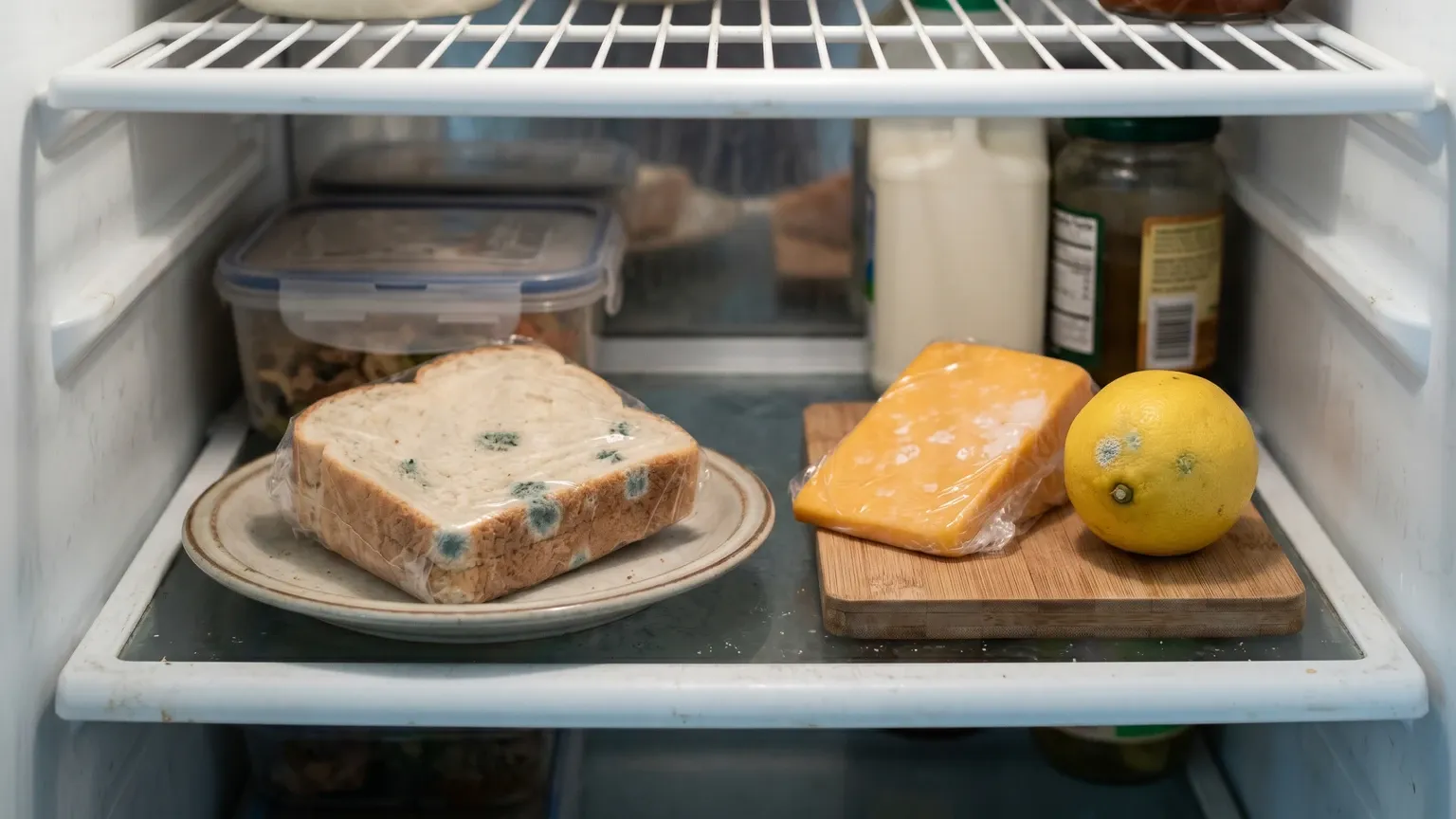
You opened the fridge and something has gone fuzzy. Whether you can eat it comes down to one question: is this food dense and firm, or soft and moist? For a small list of hard, dense foods, the USDA says cut around it with a 1-inch margin and the rest is fine. For almost everything else — bread, soft cheese, cooked leftovers, jams, soft produce, peanut butter — the answer is throw it away.
The short answer: toss vs. cut
Hard cheese (not mold-ripened varieties), hard salami, dry-cured country hams, and firm produce like cabbage, bell peppers, and carrots fall into the “cut it off” category, with at least a 1-inch margin around and below the mold spot and the knife kept out of the mold itself. Most foods — bread, soft cheese, yogurt, cooked leftovers, jams, peanut butter, soft fruits and vegetables — go in the trash. The USDA Food Safety and Inspection Service (USDA FSIS) is the federal authority on this, and their complete guidance is below.
Why food gets moldy
Mold is not a single organism. The USDA FSIS describes molds as “microscopic fungi that live on plant or animal matter” and notes that estimates of the number of species range from tens of thousands to perhaps 300,000 or more. What they share: they form spores that float through the air, settle on food, and — given the right conditions — begin growing.
Those conditions are straightforward. Mold growth is encouraged by warm and humid conditions, per USDA FSIS. Put those together with an organic food substrate and you have the complete picture: spores land on food, warmth and moisture allow the colony to establish, and the growth you see is the surface tip of a structure that may extend much deeper.
The part most people do not realize: the visible fuzz is not the whole organism. Per USDA FSIS, “Molds have branches and roots that are like very thin threads. The roots may be difficult to see when the mold is growing on food and may be very deep in the food.” That is the explanation for why the discard rules exist for soft, porous, and hollow foods — you cannot cut around what you cannot see.
Refrigeration does not solve the problem. The USDA FSIS notes that “while most molds prefer warmer temperatures, they can grow at refrigerator temperatures, too.” Molds also tolerate salt and sugar better than most other food invaders, which is why you can find mold on refrigerated jams, cured meats, and salted bologna. The fridge slows growth; it does not stop it.
The USDA FSIS table: When to Use, When to Discard
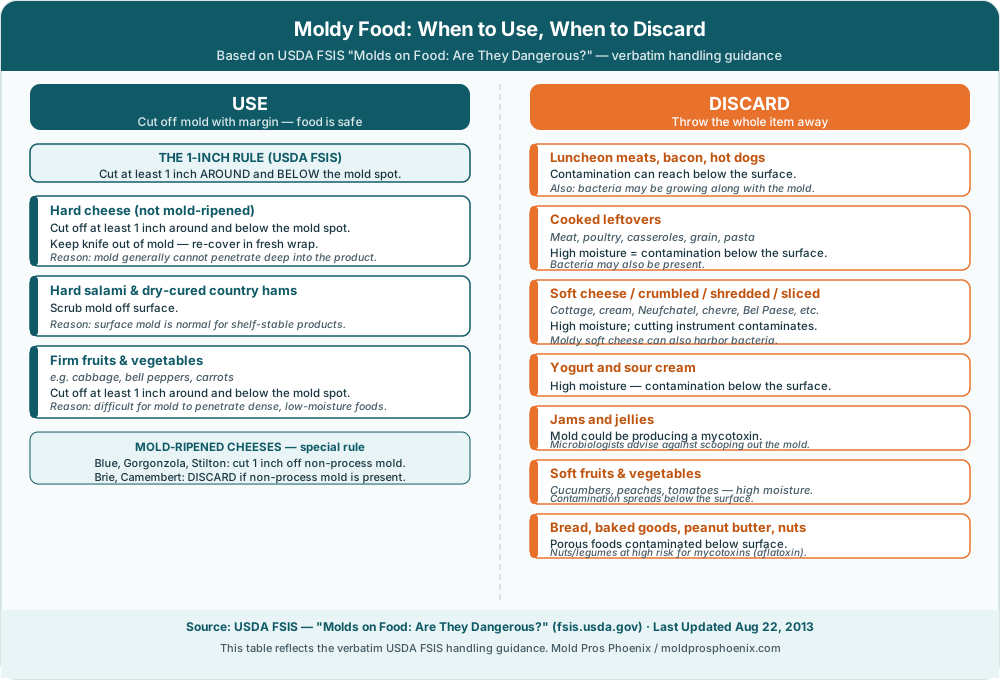
This is the complete USDA FSIS guidance table, reproduced verbatim. Every row below is the exact wording from the USDA FSIS page “Molds on Food: Are They Dangerous?” (Last Updated Aug 22, 2013; content verified via Wayback capture 20260627191529). Most food information sites reproduce a partial version of this table, or paraphrase the handling column in ways that lose the key detail. The full 14-row table is here.
| Food | Handling | Reason |
|---|---|---|
| Luncheon meats, bacon, or hot dogs | Discard | Foods with high moisture content can be contaminated below the surface. Moldy foods may also have bacteria growing along with the mold. |
| Hard salami and dry-cured country hams | Use. Scrub mold off surface. | It is normal for these shelf-stable products to have surface mold. |
| Cooked leftover meat and poultry | Discard | Foods with high moisture content can be contaminated below the surface. Moldy foods may also have bacteria growing along with the mold. |
| Cooked casseroles | Discard | Foods with high moisture content can be contaminated below the surface. Moldy foods may also have bacteria growing along with the mold. |
| Cooked grain and pasta | Discard | Foods with high moisture content can be contaminated below the surface. Moldy foods may also have bacteria growing along with the mold. |
| Hard cheese (not cheese where mold is part of the processing) | Use. Cut off at least 1 inch around and below the mold spot (keep the knife out of the mold itself so it will not cross-contaminate other parts of the cheese). After trimming off the mold, re-cover the cheese in fresh wrap. | Mold generally cannot penetrate deep into the product. |
| Cheese made with mold (such as Roquefort, blue, Gorgonzola, Stilton, Brie, Camembert) | Discard soft cheeses such as Brie and Camembert if they contain molds that are not a part of the manufacturing process. If surface mold is on hard cheeses such as Gorgonzola and Stilton, cut off mold at least 1 inch around and below the mold spot and handle like hard cheese (above). | Molds that are not a part of the manufacturing process can be dangerous. |
| Soft cheese (such as cottage, cream cheese, Neufchatel, chevre, Bel Paese, etc.) Crumbled, shredded, and sliced cheeses (all types) | Discard | Foods with high moisture content can be contaminated below the surface. Shredded, sliced, or crumbled cheese can be contaminated by the cutting instrument. Moldy soft cheese can also have bacteria growing along with the mold. |
| Yogurt and sour cream | Discard | Foods with high moisture content can be contaminated below the surface. Moldy foods may also have bacteria growing along with the mold. |
| Jams and jellies | Discard | The mold could be producing a mycotoxin. Microbiologists recommend against scooping out the mold and using the remaining condiment. |
| Fruits and vegetables, FIRM (such as cabbage, bell peppers, carrots, etc.) | Use. Cut off at least 1 inch around and below the mold spot (keep the knife out of the mold itself so it will not cross-contaminate other parts of the produce). | Small mold spots can be cut off FIRM fruits and vegetables with low moisture content. It’s difficult for mold to penetrate dense foods. |
| Fruits and vegetables, SOFT (such as cucumbers, peaches, tomatoes, etc.) | Discard | SOFT fruits and vegetables with high moisture content can be contaminated below the surface. |
| Bread and baked goods | Discard | Porous foods can be contaminated below the surface. |
| Peanut butter, legumes and nuts | Discard | Foods processed without preservatives are at high risk for mold. |
Source: USDA FSIS, “Molds on Food: Are They Dangerous?” — all 14 rows.
The 1-inch rule: how to cut correctly
For the foods in the USE column, the 1-inch margin is not a rough estimate — it is the USDA FSIS’s specific guidance. The goal is to get past the mold’s root threads, which extend below the visible surface.
The technique matters: keep the knife out of the mold itself. If the blade passes through the moldy spot, it can drag contamination into the clean portion of the food. Cut from the clean side inward, staying at least 1 inch away from the visible growth. After trimming, re-wrap the food in fresh plastic wrap, not back in the original packaging that may have mold spores on it.
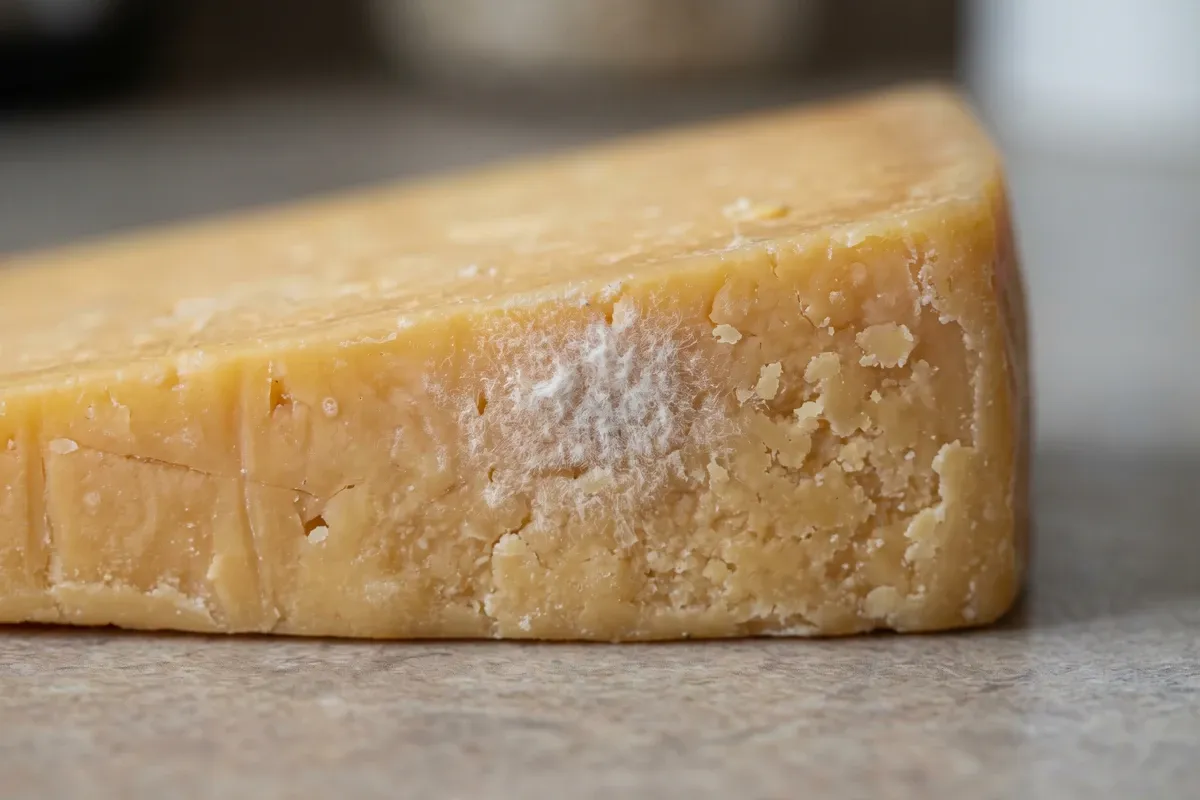
This rule applies only to the listed firm foods. It does not apply to bread, soft cheese, cooked leftovers, or any of the other discard items. The USDA FSIS note on bread is direct: “Porous foods can be contaminated below the surface.” The same spore-and-root structure that stays on the surface of dense hard cheese spreads far more easily through the spongy interior of a loaf. The visible spot on a bread slice is not the edge of the mold — it is wherever the colony happens to be visible.
Why cooking does not fix it
A common assumption is that heating moldy food to a high temperature kills the mold and makes it safe to eat. This is not correct.
Ohio State University Extension — in their food safety guide “Mold Has Grown on Your Food: What Should You Do?” (HYG-5592, Abby Snyder, Food Safety Field Specialist) — states directly: “mycotoxins are often heat stable, meaning that they will not be destroyed by cooking.”
The USDA FSIS separately explains that some molds, in the right conditions, produce mycotoxins — poisonous substances that can make you sick. Heating does not eliminate those substances. The discard guidance exists for exactly this reason: for foods where mold may have penetrated or where mycotoxin production is a concern, there is no cooking step that makes the situation safe.
Jams and jellies are the clearest case in the USDA table. The note reads: “The mold could be producing a mycotoxin. Microbiologists recommend against scooping out the mold and using the remaining condiment.” Heating the jam does not resolve this.
Do not sniff moldy food
The USDA FSIS states this plainly: “Don’t sniff the moldy item. This can cause respiratory trouble.”
The instinct to sniff something before tossing it is common. For moldy food, it is the wrong move. Bringing a moldy item close to your face and inhaling near the growth can send spores directly into the airway. Per the CDC, mold can cause respiratory symptoms, and people with mold allergies or asthma face a higher reaction risk. The USDA’s warning covers all moldy food items — not just the pungent ones.
When you find something moldy, handle it at arm’s length. The USDA FSIS says to put it in a small paper bag or wrap it in plastic and dispose of it in a covered trash can that children and animals cannot access. Then clean the spot in the refrigerator or pantry where the food was stored and check any nearby items it may have touched. “Mold spreads quickly in fruits and vegetables,” per USDA FSIS, so inspect the neighbors.
For more on how mold behaves on different materials and surfaces, the guide to mold on wood covers a related set of decisions about when to clean versus when to replace. The overall guides index has the full library of mold topics by category.
Mycotoxins: what they are and what to know
The USDA FSIS describes mycotoxins as “poisonous substances produced by certain molds found primarily in grain and nut crops, but are also known to be on celery, grape juice, apples, and other produce.” The FAO estimates that 25% of the world’s food crops are affected by mycotoxins.
The most researched of these is aflatoxin. Per USDA FSIS: “Aflatoxin is a cancer-causing poison produced by certain fungi in or on foods and feeds, especially in field corn and peanuts.” This is why peanut butter, legumes, and nuts are on the discard list — they sit among the higher-risk substrates for aflatoxin-producing molds.
The correct scope here is important. The USDA uses “some molds” and “a few molds, in the right conditions” — not “all molds produce mycotoxins.” And the CDC makes a related practical point: you do not need to know the type of mold. Color does not identify species. A black spot on bread and a gray patch on cheddar may be entirely different organisms. The USDA guidance is based on food type and moisture content, not on visual identification of the mold. What matters is whether the food is porous or dense, high-moisture or low — not what color the growth is.
What causes mold on food: the short biology
Mold spores are everywhere. The USDA FSIS notes they “can be transported by air, water, or insects” and are found in virtually every environment year-round. They land on food surfaces constantly. Most of the time, conditions are not quite right for them to establish — the food dries out, gets eaten, or the temperature is not ideal.
When conditions align — warm, a bit of humidity, a food substrate — spores germinate and the colony grows. The visible fuzz is reproductive structures. The root threads are below. The USDA FSIS describes what you are actually looking at when food molds: “gray fur on forgotten bologna, fuzzy green dots on bread, white dust on Cheddar, coin-size velvety circles on fruits, and furry growth on the surface of jellies.” These are descriptions, not species identifications. The visual tells you where the mold is and roughly what kind of food it is growing on. That is all you can determine by looking.
Not all molds are harmful. Some are intentional: the USDA FSIS notes that blue-veined cheeses like Roquefort, Gorgonzola, and Stilton are made by introducing specific Penicillium spores, and that Brie and Camembert have white surface molds that are safe to eat. Similarly, some salamis have a characteristic thin white surface mold that is normal and safe to consume, per USDA FSIS — though those products should not show any other mold.
Prevention: what actually works
The USDA FSIS lays out practical steps directly.
On storage and handling: “Buying small amounts and using food quickly can help prevent mold growth.” Use leftovers within 3 to 4 days so mold does not have a chance to grow. Keep food covered when serving to reduce exposure to airborne spores. Empty opened cans of perishable foods into clean storage containers and refrigerate promptly.
On refrigerator maintenance: “Cleanliness is vital in controlling mold.” Clean the inside of the refrigerator every few months with 1 tablespoon of baking soda dissolved in a quart of water, rinse with clear water, and dry. Scrub any visible mold on rubber casings with 3 teaspoons of bleach in a quart of water. Keep dishcloths, towels, sponges, and mops clean and fresh — “a musty smell means they’re spreading mold around.”
On indoor humidity: The USDA FSIS gives a specific federal number: “Keep the humidity level in the house below 40%.” Mold growth is encouraged by warm and humid conditions. Lower indoor humidity means fewer ideal conditions for spores that land on food to establish.
The mold removal guide covers what happens when mold establishes on household surfaces rather than food, including when to call a professional versus handle it yourself. For questions about specific mold types in the home, the guides library covers that range.
A Phoenix-specific note on food storage
For most of the year, Phoenix indoor relative humidity runs well below the USDA FSIS threshold of 40%, making food-mold conditions easier to manage than in humid regions. Monsoon season changes this. From mid-June through September, monsoon storm events can push indoor humidity above 60% during and after storms — especially in homes where the AC cycles off or loses power. A loaf of bread left on the counter in a warm, post-storm house during a power outage can hit textbook mold conditions (warm, humid, organic food substrate) within hours. The USDA FSIS 3-to-4-day leftover rule is worth treating as a firm deadline during monsoon season, and perishables left above 40°F for more than 2 hours during an outage should be discarded per FSIS food safety guidance on power outages.
For broader questions about mold in Phoenix homes — on walls, in AC systems, and in attic spaces — the mold removal page is the starting point.
Source: All handling guidance in this article is drawn verbatim from USDA FSIS, “Molds on Food: Are They Dangerous?” (fsis.usda.gov, Last Updated Aug 22, 2013; verified 2026-07-03 via Wayback capture 20260627191529). The Ohio State University Extension quote on mycotoxin heat stability is from HYG-5592 (Abby Snyder, 2018). CDC statement on mold type identification is from “About Mold,” reviewed September 26, 2024.