Mold and MCAS: What the Evidence Says About Mast Cell Activation

MCAS is a recognized clinical framework — the AAAAI has a Mast Cell Activation Disorders task force, and two peer-reviewed diagnostic criteria sets exist. Mold is documented by credentialed clinicians as a plausible trigger. Population-level evidence for mold as a specific MCAS driver is thin. The practical action for a patient is the same either way: rule out home mold and see an MCAS-familiar allergist or immunologist.
What MCAS actually is
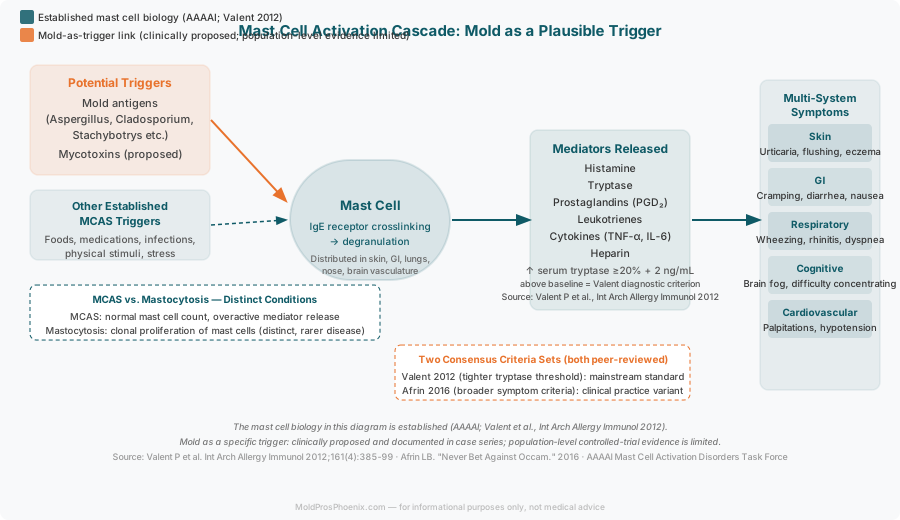
Mast cells are immune cells distributed throughout the body — in skin, the GI tract, lungs, nasal passages, and around blood vessels. Their job is to detect threats and trigger a rapid immune response by releasing chemical mediators: histamine, tryptase, prostaglandins (particularly PGD₂), leukotrienes, and cytokines including TNF-α and IL-6.
In a healthy system, mast cells activate in proportion to a genuine threat, then quiet down. In MCAS, they activate too easily, too strongly, or both — releasing mediators in response to stimuli that should not trigger a significant immune response. The result is a multi-system symptom pattern that can affect skin (urticaria, flushing, eczema-like rashes), the GI tract (cramping, diarrhea, nausea), the respiratory system (wheezing, rhinitis, shortness of breath), the cardiovascular system (palpitations, low blood pressure), and cognition (brain fog, difficulty concentrating).
MCAS is not mastocytosis. Mastocytosis is a distinct, rarer disease involving clonal proliferation of mast cells — too many mast cells, not overactive ones. A specialist can distinguish the two through bone marrow biopsy and other tests. Both conditions are real; they are not interchangeable terms.
The symptom picture in MCAS is wide enough that many patients spend years bouncing among specialists — gastroenterology, dermatology, allergy, neurology — before someone frames it correctly. The common thread is episodic symptoms that cut across multiple systems, often triggered by identifiable exposures, and that respond (at least partially) to antihistamines or mast-cell-stabilizing medications.
Diagnostic criteria — where mainstream and clinical practice diverge
There are two peer-reviewed MCAS diagnostic criteria sets, and understanding the difference matters for patients navigating the literature.
The Valent 2012 consensus (Valent P et al., International Archives of Allergy and Immunology 2012) established what most mainstream allergists use today. It requires:
- Episodic symptoms consistent with mast cell mediator release in two or more organ systems
- A serum tryptase drawn during a symptomatic episode that is at least 20% above the patient’s stable baseline, plus 2 ng/mL
- Response to antihistamines or mast-cell-stabilizing medications
The tryptase threshold is the key: tryptase is released specifically by mast cells, so a documented flare-time rise anchors the diagnosis in objective laboratory data. In practice, many patients with a convincing clinical picture have tryptase levels that don’t meet the 20%+2 threshold — which is where clinical tension arises.
The Afrin criteria (derived from Lawrence Afrin MD’s clinical work, detailed in Never Bet Against Occam, 2016, and accompanying peer-reviewed papers) take a broader view. Afrin argues that many patients with genuine MCAS have tryptase levels that don’t rise into the Valent range — either because tryptase isn’t the dominant mediator in their flares or because the blood draw doesn’t happen at peak flare. His criteria emphasize the symptom pattern, the multi-system involvement, and the clinical response to mast-cell-targeted treatment.
Both criteria sets are peer-reviewed. The core disagreement is about how much objective lab evidence is required before calling it MCAS — a meaningful clinical question, not a fringe versus mainstream dispute.
The physicians documenting mold as an MCAS trigger
These are not fringe figures. The clinicians who have specifically documented mold as an MCAS trigger hold real mainstream credentials.
Lawrence B. Afrin, MD is a hematologist-oncologist currently practicing at AIM Center for Personalized Medicine in Purchase, New York (Westchester County). He began conceptualizing MCAS as an underlying explanation for multi-system inflammatory illness in 2008. His 2016 book Never Bet Against Occam: Mast Cell Activation Disease and the Modern Epidemics of Chronic Illness and Medical Complexity laid out his clinical framework in detail. Afrin has published peer-reviewed work on MCAS and identifies mold antigens as one trigger among many that can provoke mast cell activation in susceptible patients.
Anne Maitland, MD, PhD is an Assistant Professor of Medicine (Allergy and Immunology) at the Icahn School of Medicine at Mount Sinai and Medical Director of Comprehensive Allergy and Asthma Care in Tarrytown, New York. She is a Fellow of the American College of Allergy, Asthma and Immunology (ACAAI) and a member of the AAAAI Mast Cell Activation Disorders task force. Maitland represents the mainstream academic voice on MCAS: mold is a plausible environmental trigger within a broader mast-cell framework, addressed through standard allergy and immunology evaluation.
The presence of these two physicians on the same topic matters: one works primarily in hematology-oncology with a broader MCAS diagnostic framework, the other is an allergist-immunologist on the AAAAI’s own task force. They are not from the same clinical school, yet both take mold-as-MCAS-trigger seriously.
How mold is thought to trigger mast cell activation
The proposed mechanism has two components — antigen-mediated and direct.
Antigen-mediated pathway. Mold spores carry surface antigens that sensitized individuals can react to via IgE-mediated mechanisms. IgE antibodies bind to high-affinity receptors (FcεRI) on mast cell surfaces; when mold antigens crosslink those IgE-coated receptors, degranulation follows. This is the same mechanism as classic mold allergy — the MCAS hypothesis is that in susceptible individuals, this triggers an outsized, systemic mediator release rather than a local allergic response.
Mycotoxin-direct pathway. Separately, some researchers propose that mycotoxins — secondary metabolites produced by certain molds including Aspergillus, Stachybotrys, and Penicillium species — can directly stimulate mast cell degranulation or prime mast cells for exaggerated responses. The ACMT’s 2025 position statement is explicit that indoor airborne mycotoxin exposure has not been established as a cause of systemic illness. That position does not foreclose the mast-cell biology from being real; it reflects that population-level proof is absent.
The honest framing: the individual pieces of this mechanism are biologically coherent. Mold antigens can activate mast cells via IgE — that is standard allergy medicine. Mycotoxins affect immune cells in vitro — that is documented in the peer-reviewed literature. Whether residential mold exposure drives clinically significant MCAS flares at a population level remains unproven by the standards required for federal-agency endorsement.
Important: mold does not cause MCAS. MCAS is a disorder of mast cell regulation. Mold, in this framework, is a trigger — one of many environmental exposures that may provoke flares in people who already have dysregulated mast cells. The distinction matters for treatment: removing the mold addresses a potential trigger; it does not treat the underlying condition.

What mainstream medicine says — and what it doesn’t
The mainstream position on MCAS is cleaner than the position on CIRS or “toxic mold syndrome.” MCAS is a recognized condition with an established diagnostic framework and a legitimate place in academic allergy and immunology. That is meaningfully different from conditions that mainstream bodies have declined to recognize at all.
The Institute of Medicine’s 2004 report Damp Indoor Spaces and Health — the reference framework for indoor mold and health — did not specifically address MCAS (the diagnostic criteria weren’t codified until 2012). The IOM did note sufficient evidence for mold’s association with upper respiratory symptoms, cough, wheeze, and asthma exacerbation in sensitized individuals. Multi-system immune phenotypes were not addressed by the IOM’s tier structure — meaning the research base at the time was not sufficient for a formal categorization, not that the association was disproven.
The ACMT’s 2025 position statement is more direct: it finds “no documented evidence” that indoor mold inhalation causes a chronic toxic encephalopathy and explicitly rejects urine mycotoxin panels as diagnostic tools. The ACMT position addresses the systemic mold-illness framework broadly; it does not specifically analyze MCAS.
What the evidence supports, honestly:
- MCAS is a real condition with mainstream recognition.
- Mold sensitization (mold-specific IgE) is real and common.
- Individual patients with MCAS report mold exposure triggering flares, and clinicians with real credentials document this in case series.
- A controlled population-level study demonstrating that mold exposure drives MCAS at a statistically significant rate has not been published.
That last gap is a research gap, not a refutation.
Candace Owens’s symptom cluster
Public figure Candace Owens has described, in detail on the Shawn Ryan Show (Episode 318), a severe illness she attributes to mold from an HVAC leak in her Stamford, Connecticut apartment around 2015. Her reported symptoms: head-to-toe eczema onset overnight (having never had eczema before), hair loss, athlete’s foot (first occurrence), red and discharging eyes, two episodes requiring hospital-level asthma care, and severe, prolonged brain fog — what she described as “the most intense brain fog.”
She was not publicly diagnosed with MCAS. That framing is analytic, not clinical.
The reason this cluster is worth noting on a MCAS-focused guide is that it pattern-matches almost exactly to MCAS’s multi-system presentation: episodic, multi-organ, triggered by a specific environmental exposure. Skin (urticaria/eczema), GI-adjacent immune activation, respiratory, cognitive, and ocular involvement hitting simultaneously after a new environmental exposure is exactly what a clinician assessing for MCAS would want to document. She lost a 2017 court case against her landlord for lack of a medical expert witness — the legal outcome does not speak to whether her symptoms were real or what caused them.
The pattern is worth knowing if you have similar symptoms and are looking for a diagnostic framework. That evaluation belongs with a physician, not a mold remediation guide.
Phoenix-specific MCAS considerations
Phoenix’s mold landscape is relevant to MCAS patients in a specific way: the exposure sources here tend to create prolonged, hidden antigen loads rather than acute, visible mold growth.
AC condensate mold. Phoenix air handlers run near-continuously from May through October, pulling gallons of moisture from the air each day. When a condensate drain line clogs — common after a dry winter season builds up dust and algae — water backs into the drain pan. A rusted or overflowing pan can feed mold on attic decking, duct lining, or ceiling drywall for weeks before any visible sign appears. The HVAC system then distributes spores and antigens into living areas with every cycle. For a person with MCAS, this is a sustained low-level antigen exposure, not a one-time event.
Slab-leak-driven moisture. Older Phoenix homes — particularly pre-1980 builds in Arcadia, Coronado, and central Phoenix — run on copper or galvanized supply lines under the concrete slab. Pinhole leaks wick moisture up through the slab into flooring and baseboards, creating a damp zone that feeds mold behind baseboards and under tile for months or years before detection. Chronic, hidden exposure is exactly what MCAS clinicians look for when assessing environmental triggers.
Post-monsoon roof intrusion. Phoenix monsoon season (mid-June through September) delivers intense, fast rain against aging flashing and flat or low-slope roofs. Water that gets through the roof deck or into wall cavities can seed mold growth that persists through the dry months, especially in insulation that doesn’t dry fully. A person whose symptoms flare each fall, or who worsens after a monsoon storm, has a plausible environmental pattern worth investigating.
What to do — the practical steps
If you have MCAS or suspect it, the practical sequence is:
Step 1: Get the right medical evaluation. See an allergist or immunologist — ideally one familiar with MCAS — before embarking on expensive or invasive home testing. Confirm or rule out the diagnosis. Mold testing on a home where MCAS hasn’t been evaluated is putting the cart before the horse.
Step 2: Rule out home mold in parallel, using appropriate tools. A professional moisture inspection with a calibrated moisture meter is the highest-value first step. If the inspector finds elevated moisture readings, a standard air or surface mold test by an independent industrial hygienist is the appropriate next move. Urine mycotoxin panels (RealTime Labs, Vibrant, Great Plains) are not recommended by the CDC or ACMT — they have no established reference ranges in healthy populations and their results do not change the practical response.
Step 3: Ask your physician about mold-specific IgE testing. A standard skin-prick or serum IgE test for common mold allergens (Alternaria, Aspergillus, Cladosporium, Penicillium) tells you whether you are sensitized. Sensitization is a necessary step in the IgE-mediated antigen pathway described above — if you are not sensitized to a given mold, the IgE pathway is less likely operative for that species.
Step 4: Prioritize the Phoenix-specific sources. If you are hiring a mold inspector in the Valley, specifically ask them to assess the AC condensate system (drain pan, drain line, air handler coil, visible ductwork), any areas with past water intrusion, and attic space if an attic-mounted air handler is present.
If you want to rule out home mold as an MCAS trigger, our free Phoenix mold inspection covers the specific exposure sources that matter most for MCAS patients — AC condensate systems, past water-intrusion areas, and attic air handlers — with no obligation.
This guide is for informational purposes only and does not constitute medical advice. MCAS diagnosis and treatment requires evaluation by a licensed physician. If you are experiencing symptoms described here, see a qualified allergist or immunologist.
For readers coming from a broader perspective on mold health effects, our guide on what mold sickness feels like covers the evidence-based symptom picture across the full spectrum. If brain fog is your primary concern, mold and cognitive symptoms covers the neurocognitive evidence in detail. And for the specific respiratory condition most strongly linked to indoor mold by mainstream medicine, hypersensitivity pneumonitis from home mold is the reference guide.